This message shared with the South Moreton Presbytery of the Uniting Church in Australia, Feb 2013. Relevant scripture reading is Luke 4:1-13.
I’ve just recently returned to Queensland having spent a wonderful five years living in Tasmania. I have to say that as a place it’s everything it’s cracked up to be. It’s of course beautiful, but also a great place to live, and our season there was a fantastic time for our family. We were there at the invitation of the Presbytery of Tasmania to help the presbytery resource its congregations and communities around mission development. The church in Tasmania is poised in a delicate place, but the work and opportunities to share with congregations around the state encouraging imagination and creative missional engagement was very rewarding. The future there, I think, is hopeful. Some other time I’d be happy to share some of the stories of Tassie with you.
I’m sure that it’s not only in Tasmania that there has been a heavy emphasis on the question of mission in recent times. I suspect it’s the same here, and the appointment of a project officer for mission for the Presbytery will no doubt help in your continued explorations.
The key questions we grappled with in Tasmania really emerged from the two-pronged enquiry: what is the missio dei, the mission of God? And how do we participate in it?
What does it mean to shape a congregation, faith community or agency by our understanding and answers to these kinds of question? How can we be missional? What is God up to in my neighbourhood and how do I be part of it? In my view we are right to place such emphasis on these questions of mission, and particularly in the approach to mission that observes that it’s the mission of God that has a church, not the other way around.
As we gather today at the beginning of Lent, and as questions of mission continue to be front and centre for us, I’m interested in what this scripture reading from Luke 4 has to say to us about mission. It’s a traditional reading for the beginning of Lent, and of course there are lots of ways to meet this passage.
As Jesus is tested, tempted, right at the very beginning of his ministry, of his earthly participation in God’s mission, I can’t help wondering what we can learn from this astonishing encounter about our own ministry. Continue reading →
Just recently we took our kids for their first visit to Port Arthur. It’s a place that represents a unique insight into the convict period of Tasmania’s recent history. Operating as a secondary prison, it was home to men and boys who had been shipped to the colonial convict prisons, and then re-offended in some way.
Part of the site at Port Arthur includes a restoration of what is known as the “Separate Prison”, a place of particular brutality and deprivation during its operation. Here men were essentially denied their humanity, forced to work in silence, deprived of inter-personal contact of any real sort, forced to wear masks when outside their cells. The idea was to confront the convict with their own broken-ness and force some kind of change to occur.
My kids, as we walked around the restored ruins of the separate prison, were incredulous. “How could they think this would work?” they would ask. “How could anybody be so cruel?”
We didn’t defend the choices made in those days, just observed that then, as now, people were working with what they new, what information was at hand. At that moment in time, taking away the individual humanity seemed to be an approach that might lead to restoration.
The prison has now been restored to tell a different story, the story of the men who were held there, broken there, lived and died there. Now, 150 years later, there is a sense in which humanity is being returned to this unspeakably inhumane place.
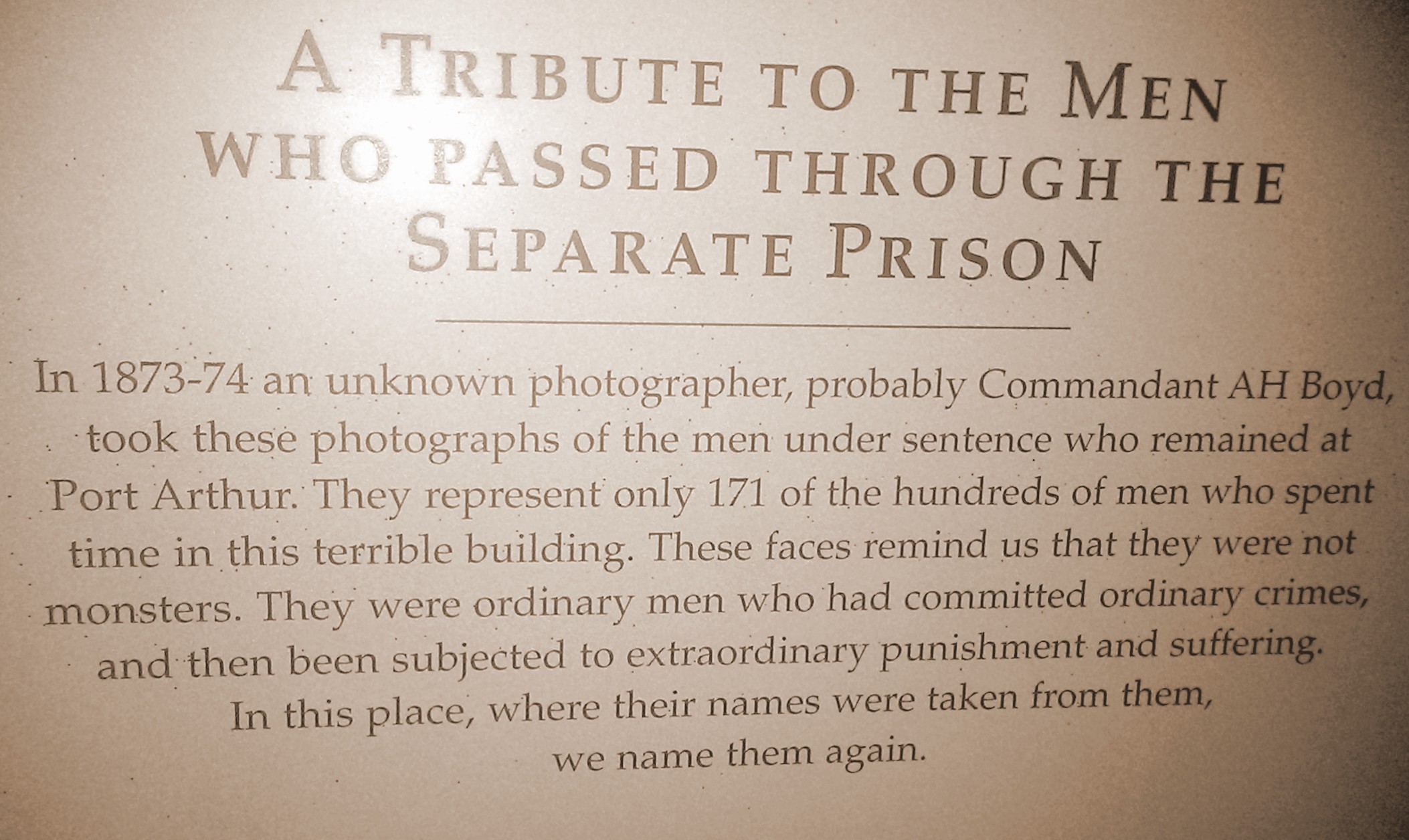
See these words for example, from a photographic installation telling the stories of the prisoners:
In this place, where their names were taken from them, we name them again.
Those are powerful words, and a powerful statement. They in some small way restore something to those who had everything taken away.
It’s a difficult time in our national story, the time of the convicts. It’s a time when so many had their names taken away.
And it parallels another difficult part of our story, when indigenous Australians likewise had their names taken, had their humanity denied, were cast as incomplete, inhuman, and unimportant.
And that is a story that generations on we still struggle to right.
In our day, in our communities, who are the others whose names are taken away?
Is it the poor, living below the poverty line, and powerless?
Is it the person living with disability, the essence of their humanity not seen by those around them?
Who else?
It strikes me that part of the purpose of God for the church is to return names to those who have been stripped bare. At the same time as we have to acknowledge that at times we have been complicit, so we have to continue to honour, to name, to respect, to humanise.
The tulip is my favourite flower. I’m not all that big on flowers in general, but tulips are incredible. The shapes, the variety of colours I find astonishing.
And so last weekend, with a day to spare and not much time left to explore Tasmania, we loaded the troops and headed north-west to check out the glorious sights of Table Cape tulip farms. It’s a couple of weeks after the famed Wynyard Tulip Festival, but we guessed there would still be plenty of colour around.
There is no arguing that it’s a spectacular scene, row upon row, wild with colour, bright against the rich red soil.
The thing is, as we got up close with the tulips, we noticed all is not as it seems from a distance.
In the neat, uniform rows, gaps appear. In the blanket of tulips, we notice that the flowers are actually not spread evenly, and not every plant bears the bright petals.
And in this picture of health and vitality, some of the individual flowers are not quite so healthy, the petals damaged by wind and rain, flowers starting to break down as they pass their prime.
There are pockets, of course, where this isn’t the case, where row upon row of late-blooming varieties are perfect.
But for the most part, look closely, and the signs are there that the spring is nearly done, that the cycle of life continues, and the health that is obvious from a distance is in fact starting to fade.
The astute gardener (which I most definitely am not!) will know that there is no point in trying to prolong the life of the flower. Now is not the time for fertiliser to try and get the flower to bloom again. The tulip’s flower is best removed as soon as it starts to fade, allowing the tulip to put all its energy into the bulb, and ensure a healthy tulip in the next growing season.
There’s no avoiding the life-cycle of the tulip, only value in recognising which part of the cycle it is in, working with the seasons, caring for the plant, flower or bulb as fits.
Sometimes that means it’s time to remove the flower from the plant, at another time to remove the bulb from the ground altogether, and later still to replant, to fertilise and water in preparation for a new growing season.
As I wandered among the rows, entranced by the variety, the beauty, and noticing the life-stage of most of the plants, I couldn’t help wondering if sometimes the same is true for our communities and churches.
There are times when we are in our prime, when things look great (and they are), and there are times when we need to recognise the fading light, or the time for renewal, for storing energy, for putting down roots and for rebirth.
Where is your community in its life cycle? What care does it need right now?
Last weekend the 8 year-old and I toddled off for a father-son campout.
It wasn’t the usual beach, river, country or mountain style camping spot – we headed straight for Launceston’s Queen Victoria Museum and Art Gallery.
Picking up the idea from the 2006 movie “A Night at the Museum”, the QVMAG threw open their doors to kids and parents to come in and sleep-over, and discover just what happens overnight in Museums.
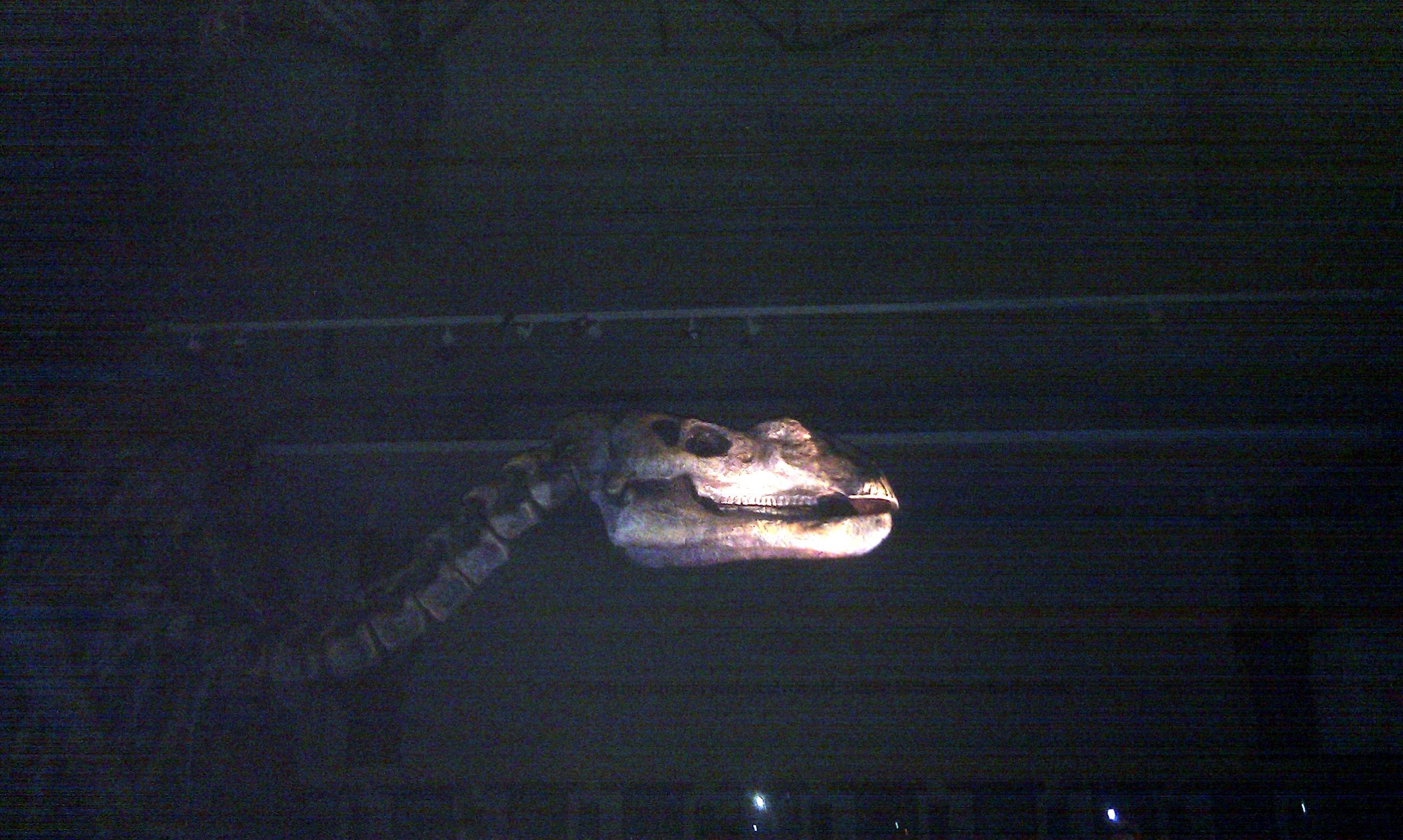
We kicked around the hands-on science exhibits, took in a preview of the upcoming Little Big Shots short film festival, sat spellbound in the planetarium touring the galaxy, took a torch-light tour through the dinosaur hall (turns out T-Rex is pretty spooky when its dark!) and finished off with bedtime stories in QVMAG’s Hooked on Books exhibit.
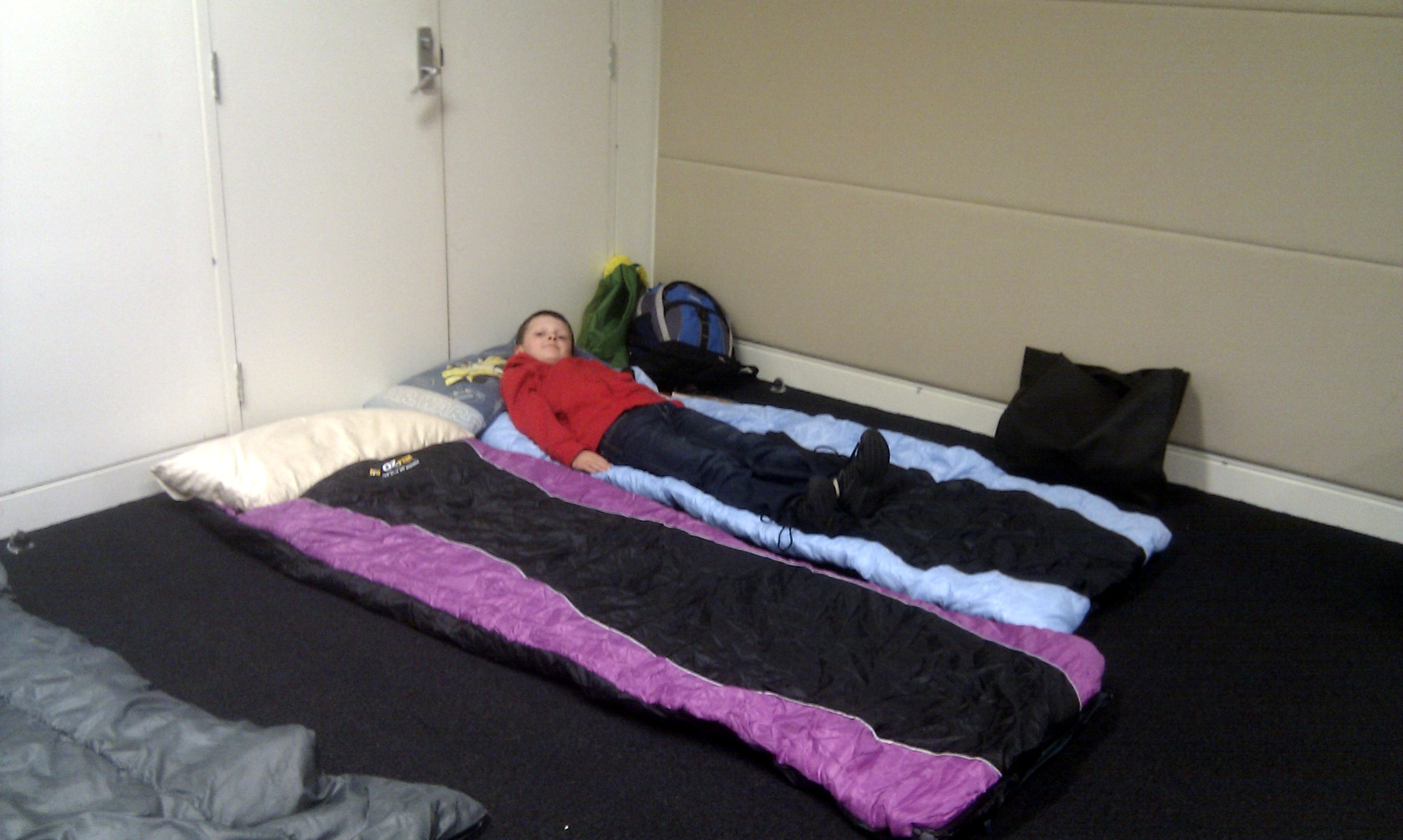
And then we (all 40 of us) retired to our temporary digs in the museum’s conference room to snore the night away. It was quite a cacophony!
Naturally we were up early the next morning for more exploring and a great pancake breakky cooked by the Museum’s director.
For a dad and boy, it was a fun night out, a real adventure that won’t be quickly forgotten. And plenty of other mums, dads, sons and daughters would back me up on that one.
There were two things about QVMAG’s Night at the Museum that I reckon are worth noting.
First is that it’s a creative way to use a facility that might seem like it’s a one-use kind of place. Nobody designed the building for camp-outs and sleep-overs. With a little imagination and re-use of the space, the QVMAG staff made it work beautifully.
And second, the event happened because one person pushed and pushed. Our host was the director of educational services, but the idea, the energy, the inspiration came from one of her junior staff members.
It took one person to have one idea, and then a bunch of imagination and hard work to make it happen.
Who is the “one person” in your community?
What is the “one idea”?
How can you back them with imagination and hard work?
QVMAG’s Night at the Museum was a great night, and I hope it runs again. I have a feeling the other two junior members of the family will want to join in for a night of adventure and exploration; a night of imagination fueled fun.
Now somebody has really done it. The life-sized LEGO style church called Abondantus Gigantus has been put up in the Netherlands for a festival. It’s not quite what I was thinking, but it’s fantastic nontheless.
Imagine how many 8 year old boys would be in this church?
Hit this link to see lots of great photos (including inside, in action) or watch the video (I hope your Dutch language skills are up to the task!) for the story of how it came to be.
Over the summer, there’s been a music video that has gone “viral”, racking up well over 40 million youtube views in just four weeks, and collecting imitations, live performances on US television shows and more.
It’s five people (a Canadian band called Walk off the Earth) playing a cover version of Gotye’s “Somebody that I used to Know”. And yep, they’re all playing on the one guitar. If you haven’t seen it, take a look:
Now I’m no musician, so I don’t know technically how hard it is to do what Walk off the Earth have done, but I find it impressive, compelling even.
And as I watch, I can’t help but admire the teamwork that’s going on in this clip. Read on for a few lessons on teamwork from Walk off the Earth.
Everybody plays a part. Everybody in a team has a part to play. Understand your part, how it contributes to the whole and be confident that your part matters. And value the part that each team member plays.
All parts are important, but not all are equal. In a teamwork environment, there are different parts, different roles to play. Each is critical. Whether you’re providing the lead vocal or the backup harmony, banging out the chords or adding the little highlights that give depth, the part you play is important. If you don’t bring your part to the table, the result will be less. Don’t underestimate your role, or that of each of your team members (even the less obvious ones).
Teamwork can be close. When you’re working in a team environment, it means working closely with the people around you (sometimes physically, as in the video). It’s critically important to do what you need to so that there is space for each other to get the job done. Sometimes that means being a little cramped, or out of your personally preferred position of way of being. But it’s a team thing, not a solo performance. Walk off the Earth describe the production of this clip as hot, sweaty and smelly. Teamwork sometimes puts us in uncomfortable places.
Not everybody is active all the time. In any teamwork there are times when the emphasis moves from one person to another, when the critical task passes along the team. Sometimes you’ll be flat out, with the whole team waiting on you, and sometimes the pressure will ease off while another takes the lead. You’re still part of the team, your presence and commitment are necessary.
You have to trust your team mates. Teams dont’ function without trust. Trusting your partners to do their job, giving them the space (and respect) so that they can, leaning on them for the support you need. Could we go so far as to say that mutual trust is the most important ingedient in successful team?
Imagination rules. Imagination is so central to much of what lies before us – no matter your field of endeavour. It’s true in teamwork as well. Imagination lets us find and explore new ways of working together; combining skills in ways that nobody has ever thought of before; reaching new and unexpected outcomes. Imagination matters, so let yours run riot.
Teamwork takes practice. Working effectively doesn’t always come naturally, easily or quickly. Sometimes it takes determined effort. Walk off the Earth have worked together for 6 years before producing this song, spent 14 hours and 26 takes to get right and describe the experience as at times being frustrating.
A long time ago, a wise man named Paul wrote something a little bit similar about the nature of team and community.
The body is a unit, though it is made up of many parts; and though all its parts are many, they form one body…
Now the body is not made up of one part but of many. If the foot should say, “because I am not a hand, I don not belong to the body,” it would not for that reason cease to be part of the body. And if the ear should say, “Because I am not an eye, I do not belong to the body,” it would not for that reason cease to be part of the body. If the whole body where an eye, where would the sense of hearing be? If the whole body were an ear, where would the sense of smell be? But in fact God has arranged the parts in the body, every one of them, just as God wanted them to be. If they were all one part, where would the body be? As it is, there are many parts, but one body.
The eye cannot say to the hand, “I don’t need you!” And the head cannot say to the feet, “I don’t need you!” On the contrary, those parts of the body that seem to be weaker are indispensable, and the parts that we think are less honourable we treat with special honour. And the parts that are unpresentable are treated with special modesty, while our presentable parts need no special treatment. But God has combined the members of the body and has given greater honour to the parts that lacked it, so that there should be no division in the body, but that its parts should have equal concern for each other. If one part suffers, every part suffers with it; if one part is honoured, every part rejoices with it.
Now you are the body of Christ, and each one of you is a part of it. (1 Cor 12:12-27)
Whether you’re thinking about a church community (or team) as you read this, or a professional situation, a sporting team or a family, there’s something here for us to think about.
If you’re leading a team, how do you help your team members get to grips with what it means to be good together?
What else do you know about teamwork? What else can you spot in this clip to teach others? Leave a comment and share it with us all….
Last week I shared some time with my colleagues here who work for the Uniting Church in the Presbytery of Tasmania.
It was partly a retreat day, partly a planning day, and partly a day of building our sense of team.
It was a day in which all sorts of interesting possibilities came alive for us, as we thought, wondered and planned how to challenge, support and nurture the church here.
As we closed the day, Carol read to us, from Romans 8:18-25, and some commentary from Macrina Wiederkehr (Seasons of Your Heart) that contained a poem. In the poem, Wiederkehr describes what must have been her own difficult birth – a birth story in which she apparently nearly didn’t make it, being momentarily pronounced dead.
I’m sure the scripture, the commentary and most of the poem were very interesting, but I confess I stopped listening. I was captured then and since by one line in the middle of the poem.
The doctor placed me aside and announced the sad news of my death, right in the middle of my birth.
Let’s just re-read that again.
The doctor placed me aside and announced the sad news of my death, right in the middle of my birth.
That’s got to be about as difficult as it gets. Right in the moment of new birth, new hope, new beginnings, is death. Just as things where about to get interesting….it was all over.
I kind of wonder if that’s about where those of us who belong to the Christian church find ourselves right now. And for the Uniting Church in Tassie it rings true.
There are well documented challenges facing the church. Buildings. Money. Age. Numbers. Ministers. Well documented.
It would be easy to pronounce death. Many have (me included).
But increasingly, I get the feeling that we’re not actually in the middle of our death….but strangely, bizarrely, in the middle of our birth.
Not because we’re about to have some explosion of numbers and reclaim the glory days of the past, but because it seems to me that we’re on the edge of discovering anew what it really means to be communities of faith, what it really means to follow Jesus in this time and place.
Somehow, we find ourselves on the edge of a time of new hope.
All over Tasmania, wherever I go, I am encountering stories in the Uniting Church of people trying new things, re-thinking what it means to live together in faith community, worship together, engage in community, participate in God’s mission.
I hear the hope in a Friday night praise and worship gathering in the rural village of Wilmot. I hear it in a lounge-room gathering in Evandale. I hear it in a wild and powerful vision of residential community in Kingston. I hear it in the quiet contemplation of a new garden at Scots Memorial. I hear it in the burgeoning community meals at Wesley. I hear it in the dreams of a first-ever website for the congregations in Hobart’s north. I hear it in the endless stories of community service that are emerging from Uniting Care Tasmania. I hear it in the stories of a cape york visit by students from Scotch Oakburn.
I hear hope everywhere.
Not fanciful, unrealistic hope.
Not hope that ignores the realities of 2011.
But simple hope. Hope that right in the middle of what we thought was our death, we might just find the possibility (and yes, pain) of birth.
I parked yesterday in a suburban street in West Launceston.
It could have been anywhere. Houses, footpaths, cars. Kids playing. People walking. A school at the top of the hill, a shop down the road.
It was so very normal. Suburbia.
And then I walked.
After two minutes I was in ‘First Basin’ where the South Esk River comes spilling out of the upper sections of Cataract Gorge, into a large open pool, before continuing down the Gorge to the waiting arms of the Tamar estuary. The water is surrounded by cliffs and hills, parkland and bushland, a 300m chairlift carrying excited school kids overhead. Peacocks fussing and preening.
It’s anything but suburbia.
And I walked again, following a trail upstream toward the delightfully named Duck Reach.
Not 10 minutes from setting out on foot from my car parked in the heartland of the suburbs I was a world away. The remnant of last week’s floodwaters tumbled down the rocky riverbed. The steep sides of the gorge deep with forest, the atmosphere still and heavy – the river and an occasional bird’s call the only sounds beyond my own footsteps.
It is a beautiful place, and all the more remarkable for being so close to the heart of the city.
At one moment I was in the normalcy of suburbia, and minutes later deep in tbe beauty of the gorge. It never ceases to amaze me that such a remarkable spot can be so close to ordinary life, literally just around the corner.
As I walked I thought a lot about that fact. I wondered how often we who are caught up in the ordinariness of daily life miss the spectacular, the remarkable, the astonishing that is just around the corner.
And I wondered about the church that I work among, so obsessed with worrying about our daily bread that we miss all the opportunities that lie just out of sight.
It seems an obvious connection. Lift our eyes from suburbia to find the remarkable that is literally on our doorstep.
But as I trod the riverside path on my way back home, something started to stir for me. I had parked my car in the middle of everything that I know, and gone off to find something better.
And how often, I wondered, is that the case? How often do we give up on all that is normal and around us to go searching for the something remarkable? How often do we leave suburbia to go hunting for Cataract Gorge?
The closer I got to my car the more I realised that suburbia is anything but ordinary. This is where I live. There are friends and family, there are stresses and tension, there is laughter of kids playing in the front yard, heartache as an amublance races to the scene of a domestic tragedy.
This, suburbia, is life. It’s not ordinary, it’s incredible. When I go looking for the amazing that I’m convinced is just around the corner I think perhaps I miss the remarkable that surrounds me right where I am.
The grass is always greener, or so we say. The salvation of my church, the restoration of my soul, the reclaiming of my world as a better place….these things are perpetually just around the corner.
Except they are not. They are right before my very eyes. They are my neighbours, my family, the shop at the end of my street. The best stuff isn’t around the corner, its right here.
There’s a spot, just off the side of the walking track that runs up through Cataract Gorge here in Launceston.
It’s one of my favourite spots. You climb a few steps up off the walking path, into a space that is dark, and sheltered, mysterious and quiet.
There in the silence there is rest, peace, freedom.
And marvellous carved and polished granite artworks. Each stone has one of two words.
Silent
Listen
And if you sit there a while, it becomes possible to do just that, listen to the silence.
I love going there, and rarely miss a chance to step off the path into this place of stillness.
Silence, I think, is one of our most under-rated resources. In a world that is constantly noisy, and in which data streams to us from every imaginable source almost without pause, silence is rare and precious.
Maybe its just the introvert talking, but today I crave silence. Stillness.
But, of course, the reverse is true. There are moments when silence is destructive. When injustice is being done, silence is complicit. When harsh words are spoken, silence can be agreement.
And so, while it is right for us to let silence do the heavy lifting (to unashamedly use the words of Susan Scott), there are moments when we have to shout loudly, to refuse to go gently into the night (to yet again use someone else’s words).
The trick then, has to be finding the right moment. Finding the time when silence is golden, when silence transforms, renews and, yes, challenges.
But to be wide open to the times when silence is the last thing that’s required. When it is exactly the right moment to call our society, our leaders to account, to speak truth to power.
Let silence do the heavy lifting, but speak clearly when it’s important. That’s what I’m learning this week.
There are two leadership quotes that I particularly love.
Lao Tzu: A leader is best when people barely know he exists, not so good when people obey and acclaim him, worse when they despise him….But of a good leader who talks little when his work is done, his aim fulfilled, they will say, “We did it ourselves.
Napoleon Bonaparte:A leader is a dealer in hope.
Leadership is not demanding, commanding, directing, or driving. It is not managing or administration.
We have an oversupply of ‘leaders’ (whether political or otherwise) who lead by being negative, by pointing out the problems in our world, the dangers we face, what we should “not” be doing.
The kind of leadership that is most effective, and that is most lacking in our world today (and if we’re honest, in our church as well) is the kind of leadership that deals in hope, that inspires initiative and energy. A truly effective leader is one who paints a picture of an alternate reality, who reveals to us what we ‘could’ be, and motivates us to go where we might not go if left to our own devices.
That’s the kind of leadership I would love to see us nurture in the Uniting Church in Tasmania.
What does it mean for you to deal in hope? Who can you encourage or inspire? What new possibilities can you imagine….and call into existence?






 ordinary wonderer