
growing older

IMG_0019So the evidence is mounting….I’m getting older.

Recently I was in the market for a car, and thought long and hard about what kind of car I could fit into my budget, what the family needs where, and what I “really” wanted. For a while at the top of my list was a Subaru WRX.  It’s been a car I’ve hankered after for years really, and though I couldn’t afford anything too recent, I could just about have worked my way into a ten year old model. As a firmly committed motoring enthusiast (to use a polite phrase!) the temptation was real. I could imagine myself dropping the kids to school, then heading for the mountains to unleash.  Serious fun lay ahead.

The choice in the end? A three year old Hyundai i30 hatch. Practical, nice, good condition, reliable, comfortable. Hyundai have come a long way and the i30 is a genuinely good small car……and I’m just about over the shame of driving a car I swore I’d never drive….but what happened to my WRX?

The thing is, much as I still love speed, and the idea of a truly capable car appeals, I’ve also started to figure out that just maybe there is more to life than going flat out everywhere.

Now in my early 40’s I find myself cruising in traffic, and laughing as a 19 year old races past, weaving in and out and gaining a few metres here and there. And as I laugh I think…sure, you’ll beat me to the destination by a few minutes, but does it really matter?

I’m definitely getting old……or maybe it’s five years in Tasmania that has relaxed me.

There are other signs too, reflexes that aren’t what they once were, a few wrinkles and a lot less hair (and disturbingly hair starting to grow in strange places…what’s with hairy ears?). Of course there are also some positives , I’ve started coping a little better with early morning starts after years of being sure and certain there was no such thing as 6.00 AM, and maybe (just maybe) there’s a little wisdom that comes from mounting levels of life experience – from all that has gone before, both good and bad.

Older, I tell you. Continue reading

thinking about planning: values

Yesterday I went off on a (fairly pointless it must be said!) flight of fancy about the comparison between GPS units and a good strategic plan.

But it did get me thinking a little more about planning.

One of the constant frustrations I have with the kind of corporate/strategic plans that we tend to produce is that often they are a lovely document, espousing all kinds of wonderful things, and published beautifully and placed on the bookshelf.

And that’s it…..there they stay.  Beside the corporate history collection and just above the pile of annual financial returns.  Sometimes, the plans we produce don’t amount to anything in terms of outcomes.

Sure the exercise of producing a plan can be helpful, can build a team, can help us think about who we are and why we are, but all that feel-good can fade into the background fairly quickly.

So what’s missing? How do we make the jump from planning as an exercise to planning that delivers outcomes?

One of the clues, I think, lies in that section of a plan we call “values”.

There’s no question its one of the critical components of any plan – the point at which we declare and describe the values of our community/organisation/company/people – those enduring tenets that define who we are.

I can’t help wondering if it’s also one of the most overlooked components. And potentially mis-used.

We tend to think, in this part of our planning, of aspirational values – those values that we hope to hold, those values that describe us at our best (and if we’re honest…we’re not at our best all the time!).

Things like hospitality, compassion, life-long learning, integrity, innovation, effective communication and so on.

Such a list of values can function as something of a collective wish-list.

And, I think, it can be a bit removed from reality, and a bit hard to grapple with these kinds of aspirational value statements.

I’m starting to think that rather than a disassociated list of aspirational values, we need to think much more in our planning exercises about embodied values, or the practices that demonstrate the kinds of values we hold/want to hold.

After all, what is a practice if not an embodied value?

What? What kind of gobbledegook is this?

If an aspirational value is hospitality, then an embodied value might be “eat a meal every week with a non-family member”.

If an aspirational value is innovation, then an embodied value might be to set aside 10% of organisation budget, and 10% of every staff member’s time for creative/innovative pursuits.

If an aspirational value is good communication, then an embodied value might be to have the CEO write a blog on the staff intranet every week outlining how the organisation is progressing, and inviting responses, comments and questions.

Those are just a couple of (admittedly incomplete) examples.

I can’t help wondering if our planning documents were to describe our aspirational values alongside a set of sample/example (but real) actions whether we might make some progress in taking that strategic plan off the bookshelf and putting it into practice.

The key would be making the plan invitational – so we (the people) are inspired to embody those values in our own work, life and participation.

And that might very well be the kind of planning that transforms an organisation or community.

Just wondering.

thinking about planning: the gps approach

GPSAt Christmas time our family gifted itself our first GPS navigation unit.  Mitch and I were about to set out on the road trip from Tasmania to Brisbane, and figured that while we’d find our way ok, some navigational assistance particularly in towns and cities might be helpful.

And it was.

We quickly got into a daily routine, with Mitch taking over GPS programming duties based on our hoped for destination and off we set – mostly following the GPS instructions – sometimes taking a side route that seemed interesting – and constantly checking in on the distance we had travelled, the distance still to go and our estimate time of arrival (or “time to beat” as we preferred to think of it).

The GPS enhanced our trip no end, and I was glad then (and many days since as we’ve reacquainted ourselves with Brisbane) that we’d fitted it to the car. I’ve no doubt we would have found our way to Brisbane anyway, but we might have taken a few wrong turns, and could easily have spent days wandering around in the mess that is the Melbourne and Sydney road systems.

Today I got to thinking about planning, and specifically about strategic planning within the organisations and groups in which I work.  And I got to wondering about the ways in which using a GPS unit is a bit like strategic planning.

Here’s where I got to:

  • the GPS tells us where we are currently
  • the GPS knows where we want to go (importantly we tell it where we want to go, not the other way around)
  • the GPS tells us how to get there – factoring in our current location, and desired destination, and then a whole lot of other information
    • external data – like the past experiences of others (historic travel times)
    • current road/traffic conditions (if we’ve sprung for a fancy unit!) that might impact on our trip and enable us to make the right choices for today
    • outlines some risks, and invites us to make some choices based on our priorities and resources (toll roads? dirt roads? ferries?)
  • if we get off track – either by our own choice or through circumstances beyond our control – the GPS helps us navigate back on track – sometimes by a simple reversal to the point where we went wrong, other times by enabling a recalculation and switch to a different route
  • the GPS enables us to constantly monitor timing, ETA (target time!), distance travelled, distance to go and see where we’ve already travelled
  • the GPS shows a level of detail required for the specific situation (like lane guidance at busy interchanges requiring careful navigation)
  • importantly, the GPS is not infallible
    • it’s only as good as it’s most recent map upload (wrong data, wrong answer!)
    • it’s only as good as the accuracy with which we define our destination
    • it needs a clear view without too much getting in the way
    • it’s prone to occasional glitching due to human error or outside interference (hello sunspots!)
  • sometimes we spend so much time playing with the GPS, we forget it is the tool, not the purpose
  • we need to remember the GPS is not the real world, it’s a description of the real world – so we have to keep one eye (ear) on the GPS, and one on the real world unfolding around us (traffic, roadwork, weather)

Like the GPS, a good plan can be gold.

Like the GPS a good plan depends on how carefully we shape it, use it, input the data, and how regularly we compare the plan’s description of the world with reality as it unfolds around us.

And like a GPS, often we’ll eventually reach the destination without a plan – but it might take a little longer, involve some detours we could do without, and for sure mean some time spent being frustrated by ring roads and freeway interchanges that send us in the wrong direction.

A good plan can be gold….if we remember it’s the tool, not the purpose.

What do you think? Where does the metaphor fall down? Where does it work for you? Or failing that….what’s your favourite GPS story? 😉

the importance of noticing

https://i0.wp.com/i.imgur.com/FpReR.jpgI had a learning moment on the weekend, right in the middle of a presentation I was making. Gotta be happy about that timing.

Over the last couple of years I’ve come to thinking of the critical questions when it comes to Christian Mission (and don’t stop reading if you’re not interested in Christianity…there’s more here than religion) are “what is God up to in our community?” and “how do we join in?”

I’ve suggested (ad nauseam it must be said) that there implication of these questions is that the first task of the Christian (or Christian community) is the task of discernment (or “figuring out”).

Last weekend I was visiting the UCA Presbytery of Central Queensland and right in the middle of telling a couple of stories from my time in Tassie that demonstrated this very point, I realised I was missing something.

Before there is opportunity to exercise discernment, to figure out what exactly is happening, what exactly are the potential responses or actions; before these things comes something more fundamental, more vital.

Noticing.

Noticing that something is happening (who knows what…that comes later…the task of discernment).

Noticing that our neighbour is in pain.

Noticing that our community is in need.

Noticing that we have some skills or resources or something to offer.

Noticing.

Maybe its obvious, but somehow it had slipped through to the keeper.  When I thought about it though, I realised that all the stories I was telling fit perfectly. And I heard another that illustrates the point:

A local UC congregation is right across the road from the school.  Someone from the church noticed that every afternoon kids were hanging out in front of the school at the bus stop waiting to be picked up – including some who had to wait quite a while before their bus arrived.  They noticed there was no shelter, and they noticed kids coming across the road to fill water bottles from a tap in the church yard when it was hot.

These things they saw and took notice of.

And then demonstrated the discernment part of the equation – the figuring out: Is there an issue here? What can we do to help? What skills/gifts/resources do we have? What is God showing us? (that question is for the Christians!)

Some might have gone the anti-community route of closing the gate and trying to keep kids from entering the church yard (you know…in case they trampled the garden). But this congregation took a different approach, and threw open the doors of the hall, inviting the waiting-for-the-bus kids to come in, find shelter and share afternoon tea.

It started with a curious few, but now there are anything up to 25 or 30 coming in for afternoon tea, building community, sharing life.

It’s a simple (but great) story.

And it started with noticing.

Now I (confession time) generally get around with the blinkers on, not noticing much that’s going on around me (ask Sheri….she’ll confirm!) but this realisation has woken me up to wonder how I can be more mindful, how I can see more clearly, how I can notice.

My first clue came in a book I’m reading called “Fierce Conversations”. I’ll talk some more about this book some other time, but the first reminder from it is to be “fully present” in every conversation. Give myself fully to the person with whom I’m talking, and not in the kind of “plan what story I’m going to share when he/she draws breathe kind of way.  Being fully present, fully engaged in what is going on around me might just help me to notice a little more.

And noticing is the first step.

I think.

passion

passion is the first in an occasional series of wonderings about the nature of the human spirit. Just because.

https://i0.wp.com/www.pinkberry.com/images/stories/webimages/yogurt_passionfruit_second.jpgI met a bloke this week, and it took all of two minutes to detect the fire that burned within him.  Here was a man whose passion was so intense that he was almost moved to tears as he spoke of what mattered to him most, and his commitment was so inspiring that I was not far behind him.
Maybe it was because it was an unexpected conversation, maybe because it was in a context where fierce, burning passion was in short supply, but it took me by surprise

That kind of passion is inspiring, and it sure inspired me. I left the conversation determined to do better, to be better, and to find the capacity within myself for that kind of commitment, that kind of single-minded determination.

I had a taste of it somewhere else this week too. I took our 9 y/old down to what we had been told was the local junior soccer club, playing in a laid back competition. Mitch is keen, but he’s only a second year soccer player, and he’s got a lot to learn about the game. We are keen for him to play, to have fun, to learn the kind of teamwork that sports can teach us, to get out in the rough and tumble of it….for all those sorts of reasons.  We were looking for a place for him to play, learn, have fun, make new mates in what is still to our family a strange new city.

To my surprise what I found was a full-on junior soccer academy, a bunch of kids from a young age being trained to be elite soccer players.  I got my first glimpse when one of the boys – a nine year old – led the squad through an intensive and technical ten minute stretching session with the coach elsewhere setting up the afternoons drills.  And it didn’t let up, 90 minutes of full-on training, the second such session of the week for the squad of under tens.  One of the dads told me the coach expects the boys to train at home doing drills for a minimum of twenty minutes each day.

For Mitch it was all a bit too much, and we’ll look for a better fit elsewhere, but what was undeniable was the passion of the coach, and of every one of the boys.  They were into everything, playing hard, training hard, fully committed to what was going on. I got the sense that there was no pushy parent syndrome here, just a bunch of boys who absolutely love their game and want to be great at it.

Once again I walked away inspired by the passion on show, and wondering just where such commitment is to be found in my own life, my own work, my own world. Where is it in yours?

Later in the week I was reading a bed time bible story to the five year old of the house, hearing about Jesus calling the first rag-tag bunch of disciples to follow him. Fishermen and tax-collectors.  Just a few years later they would burn with such passion that in spite of (because of?) their beloved leader’s death they would go to without question change the world, the very course of human history.

That same passion is what I saw and heard in the bloke whose conversation started my week long reflection on passion. The challenge now is to find it in my own journey.

Passion changes the world. Changes everything.

side by side

Part of the relocation process for our family has been finding a new faith community to connect with. We’re pretty committed to the idea of living “locally” as much as we can within a city the size of Brisbane, so we have landed at Toowong Uniting Church – a good bunch of people to hang out with, and very close to home.

Yesterday the normal 9am service went by the wayside, the congregation joining with the Brisbane Korean Uniting Church for a shared service – the first for quite a few years apparently.

It’s an interesting experience, sharing in multilingual worship, with prayers, bible readings, sermon all translated and shared twice (in English and Korean).  The team putting the service together had done a good job to ensure everybody could participate in their own language, and with a service that while perhaps slightly different to the regular pattern for both congregations, was familiar enough to satisfy most.

As a participant, it didn’t seem that hard or require much in the way of compromise for me.

We sang, encountered scripture, shared in prayer and then communion – all pretty standard stuff for those used to participating in Christian worship.

All it took was a little patience while the words were repeated in another language (and though I had no capacity to understand, I really enjoyed listening), and some small adjustments to “my” usual patterns and preferences. To be honest, I even enjoyed the points of difference.

Best of all, we kicked back with a shared lunch afterwards….and while I like the odd egg and lettuce sandwich or piece of quiche that are the hallmarks of a church lunch….the Korean community brought some truly delicious food to the table!

As we joined in (the kids enjoyed it I think as much as I did), I couldn’t help but contrast this happy community with the disgraceful public discourse around asylum seekers in Australia.

Why is it so hard for our nation to make some small accommodations to welcome those who have no place to call home?

Why do we continue to allow our political leaders to vilify and use those who are on the run for political ends?

Why do we lower ourselves with our inability to offer welcome and hospitality – maybe making a few small changes to our own patterns and preferences to accommodate our neighbour?

I’m not seriously comparing a short suburban multi-cultural church service with the complexities of international refugees, or even domestic politics.

I’m just saying….it can’t possibly be as hard as we make it (or allow it to be made).

Can it?

blogging…take 2…the ordinary wonderer

So here we go again.

I’ve just started in a new role with the Uniting Church in Queensland, our family just relocated from Tasmania and getting used to new/old places and faces, and figuring out how to survive after 6 weeks of nearly constant rain. Everything is so wet!

And it’s time to start blogging again.  This blog has been bouncing around for a while, but I’ve populated it now with some of the more interesting posts from my UCA Tasmania work blog tasmission, and will continue on from here.

It’s not – strictly speaking – a work product. Oh, I will definitely wonder aloud about the stuff I’m working on (encouraging the UCA in Queensland into deeper missional engagement) but other stuff as well.

I won’t be posting every day, maybe not even every week. But you’re welcome to stick around, comment/respond/critique/join-in if you like.

Cheers!

Scott

lessons from temptation

This message shared with the South Moreton Presbytery of the Uniting Church in Australia, Feb 2013. Relevant scripture reading is Luke 4:1-13.

I’ve just recently returned to Queensland having spent a wonderful five years living in Tasmania.  I have to say that as a place it’s everything it’s cracked up to be. It’s of course beautiful, but also a great place to live, and our season there was a fantastic time for our family. We were there at the invitation of the Presbytery of Tasmania to help the presbytery resource its congregations and communities around mission development.  The church in Tasmania is poised in a delicate place, but the work and opportunities to share with congregations around the state encouraging imagination and creative missional engagement was very rewarding. The future there, I think, is hopeful. Some other time I’d be happy to share some of the stories of Tassie with you.

I’m sure that it’s not only in Tasmania that there has been a heavy emphasis on the question of mission in recent times.  I suspect it’s the same here, and the appointment of a project officer for mission for the Presbytery will no doubt help in your continued explorations.

The key questions we grappled with in Tasmania really emerged from the two-pronged enquiry: what is the missio dei, the mission of God? And how do we participate in it?

What does it mean to shape a congregation, faith community or agency by our understanding and answers to these kinds of question?  How can we be missional?  What is God up to in my neighbourhood and how do I be part of it?  In my view we are right to place such emphasis on these questions of mission, and particularly in the approach to mission that observes that it’s the mission of God that has a church, not the other way around.

As we gather today at the beginning of Lent, and as questions of mission continue to be front and centre for us, I’m interested in what this scripture reading from Luke 4 has to say to us about mission.  It’s a traditional reading for the beginning of Lent, and of course there are lots of ways to meet this passage.

As Jesus is tested, tempted, right at the very beginning of his ministry, of his earthly participation in God’s mission, I can’t help wondering what we can learn from this astonishing encounter about our own ministry. Continue reading

returning the name

IMAG2162Just recently we took our kids for their first visit to Port Arthur.  It’s a place that represents a unique insight into the convict period of Tasmania’s recent history.  Operating as a secondary prison, it was home to men and boys who had been shipped to the colonial convict prisons, and then re-offended in some way.

Part of the site at Port Arthur includes a restoration of what is known as the “Separate Prison”, a place of particular brutality and deprivation during its operation. Here men were essentially denied their humanity, forced to work in silence, deprived of inter-personal contact of any real sort, forced to wear masks when outside their cells.  The idea was to confront the convict with their own broken-ness and force some kind of change to occur.

My kids, as we walked around the restored ruins of the separate prison, were incredulous. “How could they think this would work?” they would ask. “How could anybody be so cruel?”

We didn’t defend the choices made in those days, just observed that then, as now, people were working with what they new, what information was at hand. At that moment in time, taking away the individual humanity seemed to be an approach that might lead to restoration.

The prison has now been restored to tell a different story, the story of the men who were held there, broken there, lived and died there. Now, 150 years later, there is a sense in which humanity is being returned to this unspeakably inhumane place.

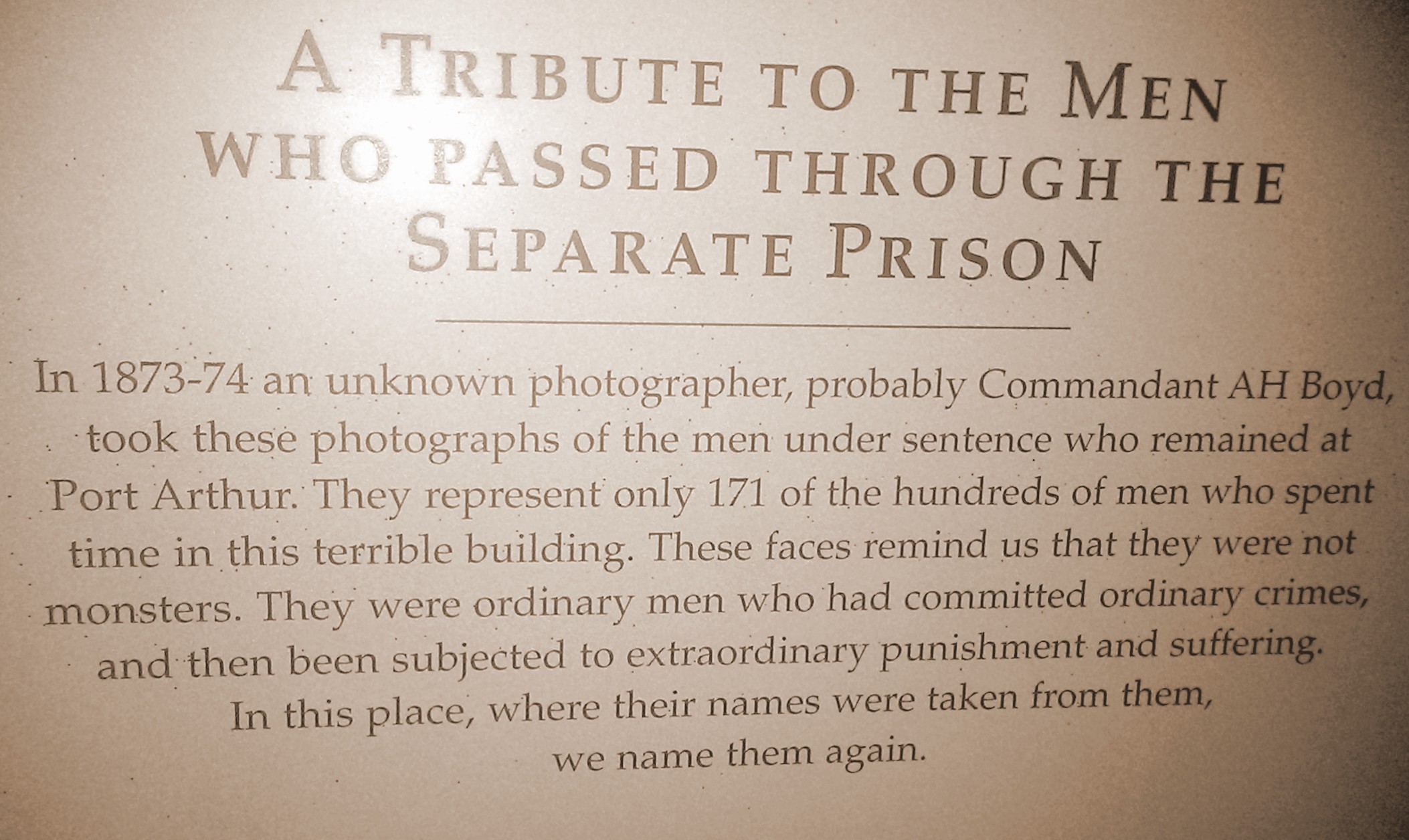
See these words for example, from a photographic installation telling the stories of the prisoners:

Port Arthur Separate Prison Words

In this place, where their names were taken from them, we name them again.

Those are powerful words, and a powerful statement. They in some small way restore something to those who had everything taken away.

It’s a difficult time in our national story, the time of the convicts. It’s a time when so many had their names taken away.

And it parallels another difficult part of our story, when indigenous Australians likewise had their names taken, had their humanity denied, were cast as incomplete, inhuman, and unimportant.

And that is a story that generations on we still struggle to right.

In our day, in our communities, who are the others whose names are taken away?

Is it the poor, living below the poverty line, and powerless?

Is it the person living with disability, the essence of their humanity not seen by those around them?

Who else?

It strikes me that part of the purpose of God for the church is to return names to those who have been stripped bare. At the same time as we have to acknowledge that at times we have been complicit, so we have to continue to honour, to name, to respect, to humanise.

Who can you honour by returning their name?

the tulip: a metaphor?

The tulip is my favourite flower.  I’m not all that big on flowers in general, but tulips are incredible. The shapes, the variety of colours I find astonishing.

And so last weekend, with a day to spare and not much time left to explore Tasmania, we loaded the troops and headed north-west to check out the glorious sights of Table Cape tulip farms. It’s a couple of weeks after the famed Wynyard Tulip Festival, but we guessed there would still be plenty of colour around.

There is no arguing that it’s a spectacular scene, row upon row, wild with colour, bright against the rich red soil.

The thing is, as we got up close with the tulips, we noticed all is not as it seems from a distance.

In the neat, uniform rows, gaps appear.  In the blanket of tulips, we notice that the flowers are actually not spread evenly, and not every plant bears the bright petals.

And in this picture of health and vitality, some of the individual flowers are not quite so healthy, the petals damaged by wind and rain, flowers starting to break down as they pass their prime.

There are pockets, of course, where this isn’t the case, where row upon row of late-blooming varieties are perfect.

But for the most part, look closely, and the signs are there that the spring is nearly done, that the cycle of life continues, and the health that is obvious from a distance is in fact starting to fade.

The astute gardener (which I most definitely am not!) will know that there is no point in trying to prolong the life of the flower. Now is not the time for fertiliser to try and get the flower to bloom again. The tulip’s flower is best removed as soon as it starts to fade, allowing the tulip to put all its energy into the bulb, and ensure a healthy tulip in the next growing season.

There’s no avoiding the life-cycle of the tulip, only value in recognising which part of the cycle it is in, working with the seasons, caring for the plant, flower or bulb as fits.

Sometimes that means it’s time to remove the flower from the plant, at another time to remove the bulb from the ground altogether, and later still to replant, to fertilise and water in preparation for a new growing season.

As I wandered among the rows, entranced by the variety, the beauty, and noticing the life-stage of most of the plants, I couldn’t help wondering if sometimes the same is true for our communities and churches.

There are times when we are in our prime, when things look great (and they are), and there are times when we need to recognise the fading light, or the time for renewal, for storing energy, for putting down roots and for rebirth.

Where is your community in its life cycle? What care does it need right now?